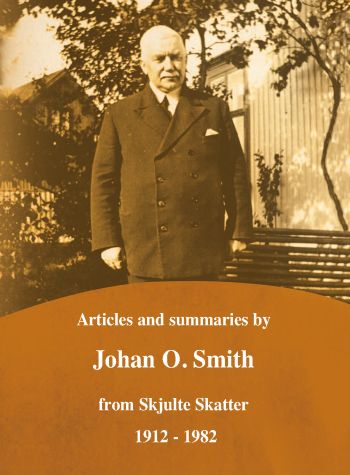
245. Sanctification’s Work of Grace
There are people who try to interpret the Scriptures without the revelation of the Spirit. In that light, which is darkness, they believe that they are light and can spread light. What deception! Recently I read a book entitled Sanctification’s Work of Grace. At the bottom of page 122 it says: “Jesus says, ‘Every branch in Me that does not bear fruit He prunes, that it may bear more fruit.’” .
In the Bible, it is written: “Every branch in Me that does not bear fruit He takes away; and every branch that bears fruit He prunes, that it may bear more fruit.” [Emphasis added].
When publishing a new book on sanctification, presumably editing and proofreading it a couple of times, it is amazing that such a huge mistake as this has gone unnoticed: “Every branch in Me that does not bear fruit He prunes, that it may bear more fruit.”
If a branch does not bear fruit, you can hardly speak about bearing more fruit. If someone who has been baptized with the Spirit into one body with Christ is slack and indifferent in his fear of God and does not exercise himself in faith, love, patience, and the like, but only thinks of earthly things and his own well-being according to the flesh—should God then prune such a branch? No, this must be an error. The author must have slipped up without realizing it because this not only goes against the Spirit of the verse, it also goes against the letter.
But there is something more written on page 12, which must be due to a lack of understanding. Not knowing any better can be understood and forgiven, but when you write a book whose aim is to teach about sanctification, and then misinterpret the Scriptures, it needs to be contested.
The author writes, “But if He (Jesus) were to draw back for a moment, we would come outside grace and outside atonement. We would be unprotected, weak, and useless, just like the man in who was ‘carnal, sold under sin.’ He had the will to do the good but was unable to perform it, and unfortunately, did the evil that he willed not to do. Finally he collapsed in this cry of despair: ‘O wretched man that I am! Who will deliver me from this body of death?’ We can be sure that this was a theoretical situation which Paul had experienced in the past but was not in at the time of writing, because he answers the cry, ‘Who?’ with ‘I thank God—through Jesus Christ our Lord!’”
The Bible says something completely different. It says: “I delight in the law of God according to the inward man.” In other words, the man in Romans 7 had an inward man that delighted in the law of God. But this new book says that the man in Romans 7 was unprotected, outside grace and outside atonement. Could his inward man even have existed without grace and without atonement? In we read, “But I see another law in my members, warring against the law of my mind, and bringing me into captivity to the law of sin which is in my members.”
Who on this earth does not have the law of sin in their members? Do we not hear quite often that people who have been baptized with the Spirit fall in adultery? Isn’t it the law of sin in their members that is extraordinarily active, so that even their mind goes along with it? Doesn’t James also write to the people of God who were scattered abroad, “Where do wars and fights come from among you? Do they not come from your desires for pleasure that war in your members?”
We see that the other law in their members often took the people of God captive and compelled them to do things that were against the law of the Spirit. This was also the case with the Corinthians. No, Paul is not imagining a theoretical situation. He only writes about realities, but it takes a mind that loves the truth to be able to admit that this is the case. The baptism of the Spirit and speaking in tongues had not caused Paul to lose his sound mind so that in a state of intoxication, he imagined theoretical situations. No, he saw and acknowledged another law in his members. If we are to grow in love, patience, generosity, and the like, a lot of what is in us must be cleansed away. Take love, for example—should we not show more love? Are we not taken captive, now and again, by coldness, impatience, and miserliness? We have the will to do the good according to the inward man, but the other law compels a person to do what he hates according to his enlightened mind. This should not be difficult for an enlightened person to understand.
Then, in , Paul exclaims: “O wretched man that I am! Who will deliver me from this body of death?”
What is the “body of death”? Obviously, it is the body that is going to die or be transformed at Christ’s return. If you are still in doubt, poke any part of your body with a pin, and you will find the “body of death.”
In other words, as long as the apostle was in the body, he had another law in his body. This is not difficult to see. You only need a little love for the truth and a little goodwill to see the other law in your own members, as well as your wife’s and your children’s, regardless of how Spirit-filled they are. We have a flesh that wars against the Spirit. That is why there are countless factions among Christians. It would be better for all of us to be rid of this body of death. Let us not say that it is something the apostle just thought up.
Then, the author of Sanctification’s Work of Grace writes, “He answers the cry, ‘Who?’ with ‘I thank God—through Jesus Christ our Lord!’”
No, and no again—this is not correct because reads:
“O, wretched man that I am! Who will deliver me from this body of death?
“I thank God—through Jesus Christ our Lord! So then, with the mind I myself serve the law of God, but with the flesh the law of sin.”
In this context, it is a little far-fetched to say that Jesus Christ is going to deliver me from this body of death. On the contrary, the apostle thanks God through Jesus Christ our Lord that, if it cannot be otherwise, he can serve the law of God with his mind and the law of sin with the flesh.
I have never read or heard that anyone can serve the law of God with his flesh. I do not know if the author of Sanctification’s Work of Grace is able to? No, I know that he could not possibly manage to do so, for in the flesh nothing good dwells. . But from we see clearly that the flesh makes itself manifest, for it is written that by the Spirit we are to put to death the deeds of the body in order to live. It must be that people with God’s Spirit in their hearts can put to death the deeds of the body by the Spirit. But deeds that are to be put to death must come from the flesh. People who write books on sanctification ought to know this. We are crucified to the manifest works of the flesh (), but the unconscious deeds of the body are still making their presence felt. That is why we are given countless exhortations. I do not doubt that the author of Sanctification’s Work of Grace does the best he can to serve the law of God with his mind under the circumstances, but I am equally certain that he serves the law of sin with his flesh. We can also see this by the fact that he tries to explain verses in Romans 7 over which he has no spiritual light whatsoever. He explains things in a carnal way and serves the law of sin with his flesh, for he goes beyond his own light and limitations and seeks help from his unenlightened human reasoning. But to no avail! Sanctification’s Work of Grace also contains many true and good things, but this does not make up for the errors. As long as the apostle was in the body of death—the body that will die—he had the other law with him in his members. We all do. However, with our enlightened mind we are to serve the law of God, not the law of sin. This is what is meant by being set free from the law of sin and death as mentioned in . We are not reading about a hypothetical situation in Romans 7, but about realities, which only those who love the truth—even the truth about their own sin—will understand. But this, too, is hidden from those who want to be wise and understanding and think they know something.
Just a few words on this occasion about the recently published book, Sanctification’s Work of Grace.
Brother Aslaksen and I have just returned from Stockholm, where we met many upright people who were seeking the truth. We did not know anyone according to the flesh, but gradually we got to know people according to the Spirit. By God’s grace, we had opportunity to preach the Word of the cross for over three weeks. God was with us in amazing ways, so many people asked us to return soon. We will write more about the trip to Sweden in the next issue.
This is the end of the 20th volume of Skjulte Skatter. God’s grace has been tremendous throughout all these years, both during the spiritual storms and calm times. I know that the paper is needed in a time like this. We have our task, even if few understand it. So with God’s help we will continue and work in the light He gives.
I recommend that everyone who wants to make progress on the way of sanctification subscribe to the paper. I wish all readers of the paper a blessed New Year.
'%3e%3cpath%20d='M6.54486%2022.9268C6.54486%2022.9268%206.53328%2022.9268%206.52749%2022.921L6.3789%2022.8188C6.36732%2022.811%206.36346%2022.7975%206.36732%2022.784C6.65292%2021.8925%206.79958%2021.3985%206.80151%2021.3946C7.50006%2019.1542%207.57532%2016.4585%207.01956%2013.6044C6.67222%2011.8233%206.53907%209.51924%206.53714%209.49608C6.32294%205.48423%207.3534%203.6568%207.98827%202.92351L8.02687%202.91772L8.17931%203.00456C8.19089%203.01228%208.19668%203.02579%208.19282%203.0393C7.99406%203.68189%207.87056%204.34956%207.87056%204.35535C7.42866%207.10132%207.83583%2012.0433%208.24878%2014.5172C8.67332%2017.0625%208.38579%2019.2411%208.38386%2019.2623C8.03073%2021.4274%207.09289%2022.483%206.56608%2022.9191L6.54678%2022.9268H6.54486Z'%20fill='black'/%3e%3cpath%20d='M17.0135%2026.4292C17.0135%2026.4292%2017.0019%2026.4292%2016.9961%2026.4234L16.8475%2026.3212C16.836%2026.3134%2016.8321%2026.2999%2016.836%2026.2864C17.0772%2025.5377%2017.2219%2025.0591%2017.2605%2024.9318C17.9648%2022.6682%2018.0439%2019.9609%2017.4882%2017.1088C17.1408%2015.3257%2017.0077%2013.0236%2017.0058%2013.0004C16.7896%208.9519%2017.8259%207.13604%2018.4627%206.41241L18.5013%206.40662L18.6518%206.49538C18.6634%206.5031%2018.6692%206.51661%2018.6653%206.53205C18.4646%207.17464%2018.3392%207.85582%2018.3392%207.86161C18.0845%209.4459%2018.1308%2011.6245%2018.2138%2013.1741L18.2215%2013.3227L18.3527%2013.2532C19.6437%2012.5797%2020.7069%2011.9005%2021.3708%2011.4509L21.4113%2011.4547L21.5271%2011.5782C21.5367%2011.5898%2021.5386%2011.6072%2021.5271%2011.6187C20.4464%2012.983%2018.4318%2014.4554%2018.3469%2014.5172L18.3141%2014.5422L18.3083%2014.5828C18.4125%2015.8641%2018.5572%2017.0779%2018.7136%2018.0234C19.1381%2020.5687%2018.8506%2022.7493%2018.8486%2022.7705C18.4955%2024.9356%2017.5577%2025.9912%2017.0309%2026.4273L17.0116%2026.435L17.0135%2026.4292Z'%20fill='black'/%3e%3cpath%20d='M10.9639%2028C10.9639%2028%2010.9484%2027.9981%2010.9446%2027.9923L10.8076%2027.8707C10.7979%2027.8611%2010.794%2027.8476%2010.7998%2027.836C11.2919%2026.5778%2011.5756%2025.804%2011.6277%2025.6612C12.7874%2022.5891%2012.9129%2018.9014%2011.9885%2014.9957C11.4116%2012.5566%2011.1877%209.39959%2011.1858%209.37064C10.7844%203.16664%2013.0344%200.750655%2014.0205%200H14.0591L14.198%200.111923C14.2077%200.121571%2014.2135%200.135079%2014.2077%200.148587C13.8005%201.09221%2013.5227%202.31564%2013.5207%202.32722C12.7874%206.08821%2013.4609%2012.8538%2014.1479%2016.2442C14.8561%2019.7389%2014.3756%2022.7203%2014.3717%2022.7512C13.704%2026.1185%2011.7782%2027.5407%2010.9812%2027.9961L10.9658%2028H10.9639Z'%20fill='black'/%3e%3c/g%3e%3cdefs%3e%3cclipPath%20id='clip0_3867_12532'%3e%3crect%20width='28'%20height='28'%20fill='white'/%3e%3c/clipPath%3e%3c/defs%3e%3c/svg%3e)