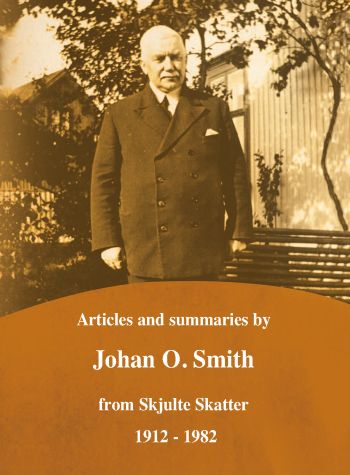
243. The Liberty of Christ and Religious Bondage to Sin
“For freedom Christ has made us free.” [Norw.]. It is so good and blessed to be free. Sin binds, but Christ sets free. The Spirit of Jesus Christ leads us to the bonds that bind us. And if we are willing to confess and acknowledge our sin, we will be free indeed. The mind of the Spirit is always life and peace, always liberation, victory, comfort, and joy. Stand fast therefore in this liberty and do not be bound and entangled again with a yoke of bondage—not by sin, nor by people who are bound by sin. We have one Lord and Master; that is, our Lord Jesus Christ. All apostolic ministry, teaching, and shepherding, all prophetic speech that is of God points toward liberation from sin. It will lead a person into fellowship with the saints. By this the spirits can be tested. But who is sufficient for testing spirits if they themselves are not free? Only when I have been set free from sin can I judge my position. If we are in bondage to sin, we need help to come out of it. But who are really the right helpers for this? We know that Jesus’ sacrifice liberates us from sin once for all, but where are Christ’s co-workers who, as the one among a thousand, can show man his right way so he is not brought into bondage again and again by sin, and by people who are seeking their own? [Norw.]. There are many sheep seeking food, but where are the shepherds? Where are the pastures?
“This is the word that came to Jeremiah from the Lord, after King Zedekiah had made a covenant with all the people who were at Jerusalem to proclaim liberty to them: that every man should set free his male and female slave—a Hebrew man or woman—that no one should keep a Jewish brother in bondage.
“Now when all the princes and all the people, who had entered into the covenant, heard that everyone should set free his male and female slaves, that no one should keep them in bondage anymore, they obeyed and let them go.
“But afterward they changed their minds and made the male and female slaves return, whom they had set free, and brought them into subjection as male and female slaves.” Jer. 34.
This is exactly how people are. As long as there is revival, as long as the Lord is working powerfully by His grace, they are willing; they set free, they bring the sacrifices, shout “Hallelujah,” speak in tongues and prophesy. But when the times of trial come, each one makes his male and female slaves return. They return to their old sins and former habits—they are no longer free nor do they set others free. Once again they become old, obstinate sinners with an undertone of religiosity—the old misers who continually say, “Give, give,” and who need grace over all their ungodliness. That is why they cannot bear a single word of truth—they only want grace. And as in the former days, they have a multitude of preachers to be their spiritual comforters. But what does the Lord say? “‘You have not obeyed Me in proclaiming liberty, every one to his brother and every one to his neighbor. Behold, I proclaim liberty to you,’ says the Lord—‘to the sword, to pestilence, and to famine! And I will deliver you to trouble among all the kingdoms of the earth.’” .
That is what the Lord does when people do not obey Him. These are the laws of the Spirit, for the Lord is the Spirit. It is not only in Jerusalem and Israel that He does this—no, He does it among every nation under heaven.
Pastor Fredrik Wisløff wrote an article about the situation in America, where apostasy is rampant, in the September 20 edition of For Rich and Poor this year. Two posters were displayed outside an Episcopal church in Brooklyn just before Christmas. One advertised communion, and the other a dance. One door led to the church, and another to the dancehall. Wisløff went in to examine the matter more closely. He writes, “The dance was in full swing! The floor was full of young couples, the ladies dressed in the latest ball gowns. The orchestra was one of Brooklyn’s best, producing the most cutting jazz; drums, saxophones, clarinets, etc. Occasionally people would sing along to the music. The whole thing was broadcast.
“The leader called for silence and announced the next dance. And away they went again. Almost only young people were present. An elderly man took tickets and two older ladies were cooking sausages in the kitchen. Apart from that, there were only young people. A poster advertised ‘Hot Dogs’ for 10 cents each.
“There was a short break and out came the cigarettes. But it did not last for long, and they continued.
“Now the leader suggested dimming the lights. Everyone agreed. So the colored lights under the ceiling were switched off, and a light by the door turned on, which constantly changed from red to green to purple, etc. This was intended to create interesting lighting effects on the ladies’ ball gowns as they passed the middle of the floor during the dance. Apart from that, the hall was in semi-darkness.
“A young couple sat opposite us, the girl sitting herself down on his lap. The corners of the room were completely dark. We got up, found our coats and left. We had had enough! We felt empty, sad, and angry.” Pastor Wisløff continues:
“I knelt by my bed that evening and prayed a sincere prayer for the ‘Christian church.’ I was reminded of the word about the abomination of desolation in the holy place. I was reminded of the terrible depiction of ‘the great harlot’ in the Bible. Now I had seen her, more crass than ever before.”
When even the priests approve these “Dance and hot dog” evenings, where the profits go to “God’s cause,” you can imagine how dark things have become. Business is good and “anything goes.”
But has it not always been like this? Ezekiel writes in Chapter 22: “Her priests have violated My law and profaned My holy things; they have not distinguished between the holy and unholy, nor have they made known the difference between the unclean and the clean; and they have hidden their eyes from My Sabbaths, so that I am profaned among them.”
“Her prophets plastered them with untempered mortar, seeing false visions, and divining lies for them, saying, ‘Thus says the Lord God,’ when the Lord had not spoken.”
“The people of the land have used oppressions, committed robbery, and mistreated the poor and needy . . .”
“So I sought for a man among them who would make a wall, and stand in the gap before Me on behalf of the land, that I should not destroy it; but I found no one.”
Truly, the sanctuaries of God are trodden down in our days. We do not need to travel to America to see that. Where are the priests that teach the people to discern between the holy and the unholy, the impure and the pure, and to stand in the gap before God’s face?
But it will be as in the days of Jeremiah: “‘Therefore I have poured out My indignation on them; I have consumed them with the fire of My wrath; and I have recompensed their deeds on their own heads,’ says the Lord God.” .
It is good to keep to the Word of the Lord and not turn away from it, neither to the right nor the left.
Today people are taught that doing God’s will is right, but if someone does so, and their life is turned around, people immediately say, “That man is crazy!” Both the priest and the prophet agree on this point. God’s Word and God’s will transform people so that all things become new. Old things have passed away. But now the priest and prophet think the old things are very good and the new things are totally wrong. Is this not powerful evidence that “God’s Way” is completely hidden? Salaries and collections are much more precious than the Way, which is new and living and goes through the veil, that is, His flesh. The natural man cannot study his way to becoming a priest. You become a priest by being born again, as Peter says:
“But you are a chosen generation, a royal priesthood, a holy nation, His own special people, that you may proclaim the virtues of Him who called you out of darkness into His marvelous light.” [Norw.].
Priests who have not come out of darkness into His marvelous light cannot proclaim the virtues of Christ. It follows that they are not God’s priests either, even if they have been appointed by the people. A priest must have something to sacrifice. Today the things to be sacrificed are within the body, and how is it possible you sacrifice something within your body when you have not even been able to free yourself from the sin that is outside your body? .
Our “holy church,” as they call it, cannot help anyone—it cannot even get itself out of its own predicament. Personal initiative is much more useful than priests and religious institutions. Each individual must take the kingdom of heaven by force. You cannot expect any help from the priests and churches to do that.
'%3e%3cpath%20d='M6.54486%2022.9268C6.54486%2022.9268%206.53328%2022.9268%206.52749%2022.921L6.3789%2022.8188C6.36732%2022.811%206.36346%2022.7975%206.36732%2022.784C6.65292%2021.8925%206.79958%2021.3985%206.80151%2021.3946C7.50006%2019.1542%207.57532%2016.4585%207.01956%2013.6044C6.67222%2011.8233%206.53907%209.51924%206.53714%209.49608C6.32294%205.48423%207.3534%203.6568%207.98827%202.92351L8.02687%202.91772L8.17931%203.00456C8.19089%203.01228%208.19668%203.02579%208.19282%203.0393C7.99406%203.68189%207.87056%204.34956%207.87056%204.35535C7.42866%207.10132%207.83583%2012.0433%208.24878%2014.5172C8.67332%2017.0625%208.38579%2019.2411%208.38386%2019.2623C8.03073%2021.4274%207.09289%2022.483%206.56608%2022.9191L6.54678%2022.9268H6.54486Z'%20fill='black'/%3e%3cpath%20d='M17.0135%2026.4292C17.0135%2026.4292%2017.0019%2026.4292%2016.9961%2026.4234L16.8475%2026.3212C16.836%2026.3134%2016.8321%2026.2999%2016.836%2026.2864C17.0772%2025.5377%2017.2219%2025.0591%2017.2605%2024.9318C17.9648%2022.6682%2018.0439%2019.9609%2017.4882%2017.1088C17.1408%2015.3257%2017.0077%2013.0236%2017.0058%2013.0004C16.7896%208.9519%2017.8259%207.13604%2018.4627%206.41241L18.5013%206.40662L18.6518%206.49538C18.6634%206.5031%2018.6692%206.51661%2018.6653%206.53205C18.4646%207.17464%2018.3392%207.85582%2018.3392%207.86161C18.0845%209.4459%2018.1308%2011.6245%2018.2138%2013.1741L18.2215%2013.3227L18.3527%2013.2532C19.6437%2012.5797%2020.7069%2011.9005%2021.3708%2011.4509L21.4113%2011.4547L21.5271%2011.5782C21.5367%2011.5898%2021.5386%2011.6072%2021.5271%2011.6187C20.4464%2012.983%2018.4318%2014.4554%2018.3469%2014.5172L18.3141%2014.5422L18.3083%2014.5828C18.4125%2015.8641%2018.5572%2017.0779%2018.7136%2018.0234C19.1381%2020.5687%2018.8506%2022.7493%2018.8486%2022.7705C18.4955%2024.9356%2017.5577%2025.9912%2017.0309%2026.4273L17.0116%2026.435L17.0135%2026.4292Z'%20fill='black'/%3e%3cpath%20d='M10.9639%2028C10.9639%2028%2010.9484%2027.9981%2010.9446%2027.9923L10.8076%2027.8707C10.7979%2027.8611%2010.794%2027.8476%2010.7998%2027.836C11.2919%2026.5778%2011.5756%2025.804%2011.6277%2025.6612C12.7874%2022.5891%2012.9129%2018.9014%2011.9885%2014.9957C11.4116%2012.5566%2011.1877%209.39959%2011.1858%209.37064C10.7844%203.16664%2013.0344%200.750655%2014.0205%200H14.0591L14.198%200.111923C14.2077%200.121571%2014.2135%200.135079%2014.2077%200.148587C13.8005%201.09221%2013.5227%202.31564%2013.5207%202.32722C12.7874%206.08821%2013.4609%2012.8538%2014.1479%2016.2442C14.8561%2019.7389%2014.3756%2022.7203%2014.3717%2022.7512C13.704%2026.1185%2011.7782%2027.5407%2010.9812%2027.9961L10.9658%2028H10.9639Z'%20fill='black'/%3e%3c/g%3e%3cdefs%3e%3cclipPath%20id='clip0_3867_12532'%3e%3crect%20width='28'%20height='28'%20fill='white'/%3e%3c/clipPath%3e%3c/defs%3e%3c/svg%3e)