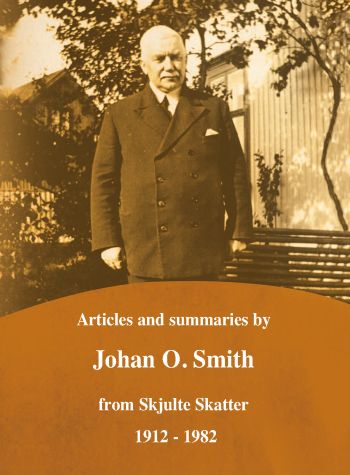
314. Seventy Ways to Heaven
Some might ask why it says “Seventy Ways to Heaven” when there is only one way. When you are outside of “the Way,” then all you can see is one way. But when you are a disciple (apprentice) and begin to walk on the way, you discover that there are just as many ways against the sinful desires of the flesh as there are laws written in your heart and mind. . The new and living way goes through the veil, that is, His flesh. .
The Scriptures do not only speak about “the Way,” they also speak about “ways.” “For all His ways are justice . . . .” . “Show me Your ways, O Lord; teach me Your paths.” . Solomon said about wisdom, “Her ways are ways of pleasantness, and all her paths are peace.” . Paul wrote in , “How unsearchable are His judgments and His ways past finding out!”
Brother Aslaksen chose to write about seventy ways: the way of humility, the way of prayer, the way of patience, the way of love, etc., in order to shine light on these various ways, which are on the one great Way, Jesus Christ. At the same time, it was to agitate and shake up people who were foolish and slumbering regarding the kingdom of God.
The forgiveness of sins is a washing of the body with pure water; so that is not a way, neither is baptism nor the baptism in the Spirit. All these things equip us to go on “the Way,” but they themselves are not “the Way.”
We were buried with Him in baptism. A burial is not a way. Afterward we were raised with Him from the dead, so that we should walk in newness of life. . The walk comes after baptism.
“However, when He, the Spirit of truth, has come, He will guide you into all truth . . . .” . If I do not walk on the way and allow Him to lead me, His leadership is quenched, and it becomes inactive.
Disciples allow the Master to teach them through His Spirit, but this process takes time. Just as in any apprenticeship, the apprentice must be instructed by his master in order to become like him. During the course of this education, we need to be precise, patient, and attentive so we do what we are instructed to do. In this process we become aware of thousands of laws and commandments. However, after we have been trained, we have no tolerance for shoddy and incomplete work; we find it unacceptable. It is just the same in the school of the Spirit. We do not have any faith in leaping from the theater to the pulpit. Neither are we taken in by preachers who preach about the forgiveness of sins, baptism by water, and baptism of the Spirit when we recognize that they do not have the spirit of discipleship. Those who hear us are of God, the apostle John says.
I highly recommend this book. It lends itself well to Bible studies in some circles, as well as good homework for preachers.
'%3e%3cpath%20d='M6.54486%2022.9268C6.54486%2022.9268%206.53328%2022.9268%206.52749%2022.921L6.3789%2022.8188C6.36732%2022.811%206.36346%2022.7975%206.36732%2022.784C6.65292%2021.8925%206.79958%2021.3985%206.80151%2021.3946C7.50006%2019.1542%207.57532%2016.4585%207.01956%2013.6044C6.67222%2011.8233%206.53907%209.51924%206.53714%209.49608C6.32294%205.48423%207.3534%203.6568%207.98827%202.92351L8.02687%202.91772L8.17931%203.00456C8.19089%203.01228%208.19668%203.02579%208.19282%203.0393C7.99406%203.68189%207.87056%204.34956%207.87056%204.35535C7.42866%207.10132%207.83583%2012.0433%208.24878%2014.5172C8.67332%2017.0625%208.38579%2019.2411%208.38386%2019.2623C8.03073%2021.4274%207.09289%2022.483%206.56608%2022.9191L6.54678%2022.9268H6.54486Z'%20fill='black'/%3e%3cpath%20d='M17.0135%2026.4292C17.0135%2026.4292%2017.0019%2026.4292%2016.9961%2026.4234L16.8475%2026.3212C16.836%2026.3134%2016.8321%2026.2999%2016.836%2026.2864C17.0772%2025.5377%2017.2219%2025.0591%2017.2605%2024.9318C17.9648%2022.6682%2018.0439%2019.9609%2017.4882%2017.1088C17.1408%2015.3257%2017.0077%2013.0236%2017.0058%2013.0004C16.7896%208.9519%2017.8259%207.13604%2018.4627%206.41241L18.5013%206.40662L18.6518%206.49538C18.6634%206.5031%2018.6692%206.51661%2018.6653%206.53205C18.4646%207.17464%2018.3392%207.85582%2018.3392%207.86161C18.0845%209.4459%2018.1308%2011.6245%2018.2138%2013.1741L18.2215%2013.3227L18.3527%2013.2532C19.6437%2012.5797%2020.7069%2011.9005%2021.3708%2011.4509L21.4113%2011.4547L21.5271%2011.5782C21.5367%2011.5898%2021.5386%2011.6072%2021.5271%2011.6187C20.4464%2012.983%2018.4318%2014.4554%2018.3469%2014.5172L18.3141%2014.5422L18.3083%2014.5828C18.4125%2015.8641%2018.5572%2017.0779%2018.7136%2018.0234C19.1381%2020.5687%2018.8506%2022.7493%2018.8486%2022.7705C18.4955%2024.9356%2017.5577%2025.9912%2017.0309%2026.4273L17.0116%2026.435L17.0135%2026.4292Z'%20fill='black'/%3e%3cpath%20d='M10.9639%2028C10.9639%2028%2010.9484%2027.9981%2010.9446%2027.9923L10.8076%2027.8707C10.7979%2027.8611%2010.794%2027.8476%2010.7998%2027.836C11.2919%2026.5778%2011.5756%2025.804%2011.6277%2025.6612C12.7874%2022.5891%2012.9129%2018.9014%2011.9885%2014.9957C11.4116%2012.5566%2011.1877%209.39959%2011.1858%209.37064C10.7844%203.16664%2013.0344%200.750655%2014.0205%200H14.0591L14.198%200.111923C14.2077%200.121571%2014.2135%200.135079%2014.2077%200.148587C13.8005%201.09221%2013.5227%202.31564%2013.5207%202.32722C12.7874%206.08821%2013.4609%2012.8538%2014.1479%2016.2442C14.8561%2019.7389%2014.3756%2022.7203%2014.3717%2022.7512C13.704%2026.1185%2011.7782%2027.5407%2010.9812%2027.9961L10.9658%2028H10.9639Z'%20fill='black'/%3e%3c/g%3e%3cdefs%3e%3cclipPath%20id='clip0_3867_12532'%3e%3crect%20width='28'%20height='28'%20fill='white'/%3e%3c/clipPath%3e%3c/defs%3e%3c/svg%3e)