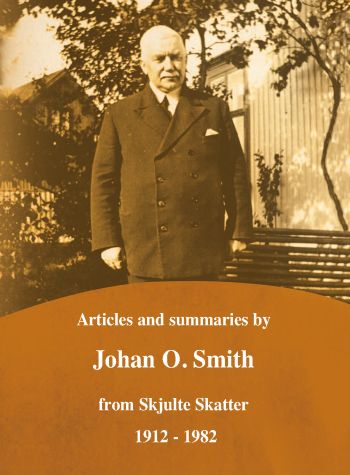
228. An Answer to “Victory on the Cross”
Pastor Barratt contends—with no evidence—that our doctrine concerning Jesus is undoubtedly one of the most dangerous that has come forth in our time and is simply the result of twisting the pure Word of God. As a result, he feels it is his responsibility to warn people against thinking the way we think.
Pastor B. has become a prominent man in our country, and his paper may provoke unenlightened people. It may appear an easy matter for him to crush our little flock and our lowly work. He is welcome to do that, if he is able; for we love what is true and right even if it comes from Pastor B.
But let’s get to the issue:
Pastor B. says that Jesus was like Adam before the Fall. Where in the Bible is that written? The Seed of the woman was to bruise the serpent’s head (), and we know that Adam and Eve received their firstborn (Cain) after the Fall (). Please explain your statement in more detail, so we can correct our false doctrine. Before the Fall Adam walked around naked and was not ashamed. Why did Jesus walk around fully clothed? Was He ashamed? Before the Fall Adam did not know the difference between good and evil. . Was this true of Jesus also, that He didn’t know the difference between good and evil, since He was like Adam before the Fall? You are a teacher. Please instruct us. We are willing students, and if you are right, we will gladly admit it.
You refer to the scholars Dr. Campbell Morgan and Dr. Whedon (Methodist theologians). Where do we read in the Bible that we should go to scholars in order to be convinced of the truth? Please answer so that we can get things straight here. In my Bible I read that the Spirit of truth will lead us into all the truth. .
You say that the first Adam was perfect as was the second Adam. Would you please explain then how it was that the first Adam could know nothing of the difference between good and evil, yet the second Adam learned obedience by the things that He suffered? . Explain it carefully because this is extremely interesting for us!
You say that we interpret incorrectly to support our theory. God sent His Son in the likeness of sinful flesh, not in sinful flesh. Again we permit ourselves to ask the question, “Where was sin condemned?” Was it in the likeness of sinful flesh? It is obvious that it was condemned in the flesh, and that is the crux of the whole matter. Please give us a clear and sensible answer!
Was Jesus a High Priest when He walked here on the earth, or was He made a High Priest after His death and resurrection? You do not explain yourself clearly on this point. Please tell us if He was separate from sinners and made higher than the heavens during the days of His flesh, since according to the Scriptures, He was made a little lower than the angels.
It seems to me that Pastor. B. has a problem differentiating between “the body of the flesh” () and “the body of sin” (). Some time ago, the Storm-Monson brothers comforted Pastor B. with an article stating that the body of sin was “put off,” and they gave as a reference. Barratt published this article in a prominent section of his paper to provide comfort and to offset any contradiction within his own assembly. This clearly shows that both Storm-Monson and Barratt are totally ignorant about these matters. I think these gentlemen would greatly benefit from some Bible studies with the little group that meets at Idrettens Hus [a hall where the Oslo church held their meetings at that time], where they could learn about the difference between the body of sin, the body of flesh, and the body of death.
Now and again, over the course of time, I have read Pastor Barratt’s holiness theories, but I have always found that the concepts he dishes out are quite confusing.
Pastor B. writes in his booklet “What Do ‘Pentecostals’ Believe?”
On page 7: “The inner cleansing takes place as an instant work of grace, by the Holy Spirit; God’s fire falls on the sacrifice, consumes the sin in our inner being, and cleanses us completely, through and through (), and the love of God is poured out in our hearts. Rom. 5.”
So this is what the Pentecostals believe. But what happens in practice? Has all covetousness and the love of money been destroyed? Has bias and respect of persons vanished from the life of Pastor B. and all the others? Has all begging, both obvious and disguised, disappeared? Are they no longer seeking to get a fancy car from some poor church member? Has he stopped taking expensive trips to east and west? Is a sharp eye being kept to ensure that the fatherless and widows are not being oppressed? Are they destroying sin in their inner being? Is the love of God prevailing to the point that each woman is in subjection to her husband, and the greatest sees himself as the least? Is there never a need to call in the police because sin is gone, and with it, the need for assistance from this world? Is the love that bears all things the ruling force? Does no one commit adultery any more since the desire for all such things has been removed? Does a party spirit no longer exist?
If indeed Pastor B. and all the Pentecostals live and practice their holiness doctrine in this way, then I and the entire assembly at Idrettens Hus will immediately be reconciled with our dear friends across the street. However, should we discover that such is not the case, excuse us if we stay away.
On page 6 we read, “The indwelling sin and ‘the lusts of the flesh’ are taken away” (), “and the ‘old man’ is not only bound but cast out!”
Pastor B. makes no distinction between “having sin” and “committing sin.” The Bible says, “If we say that we have no sin, we deceive ourselves, and the truth is not in us.” .
Barratt has no more sin in his flesh, and therefore must be deceived. According to him, the flesh no longer strives against the Spirit, and the Spirit against the flesh. We observe from his holiness teaching, explained on page 9 under the heading Sanctification, that “the flesh lusts against the Spirit” and rules in all those who are carnal. According to this, it seems that Pastor B. thinks that those who have received God’s Spirit do not have a flesh that wars against the Spirit.
How can such a man as Pastor Barratt dare to teach and discipline other assemblies when he is so confused about his own holiness doctrine? Not only that, but it is a well-known fact that his own Pentecostal people do not comply with his doctrine. He says he feels responsible. I can assure Pastor B. that God never made him responsible for an area in which he himself stumbles around in darkness. We, too, have heard what the Spirit is saying in the church. It just amazes me that the Pentecostals in Norway can follow a man with such unreal illusions about holiness.
'%3e%3cpath%20d='M6.54486%2022.9268C6.54486%2022.9268%206.53328%2022.9268%206.52749%2022.921L6.3789%2022.8188C6.36732%2022.811%206.36346%2022.7975%206.36732%2022.784C6.65292%2021.8925%206.79958%2021.3985%206.80151%2021.3946C7.50006%2019.1542%207.57532%2016.4585%207.01956%2013.6044C6.67222%2011.8233%206.53907%209.51924%206.53714%209.49608C6.32294%205.48423%207.3534%203.6568%207.98827%202.92351L8.02687%202.91772L8.17931%203.00456C8.19089%203.01228%208.19668%203.02579%208.19282%203.0393C7.99406%203.68189%207.87056%204.34956%207.87056%204.35535C7.42866%207.10132%207.83583%2012.0433%208.24878%2014.5172C8.67332%2017.0625%208.38579%2019.2411%208.38386%2019.2623C8.03073%2021.4274%207.09289%2022.483%206.56608%2022.9191L6.54678%2022.9268H6.54486Z'%20fill='black'/%3e%3cpath%20d='M17.0135%2026.4292C17.0135%2026.4292%2017.0019%2026.4292%2016.9961%2026.4234L16.8475%2026.3212C16.836%2026.3134%2016.8321%2026.2999%2016.836%2026.2864C17.0772%2025.5377%2017.2219%2025.0591%2017.2605%2024.9318C17.9648%2022.6682%2018.0439%2019.9609%2017.4882%2017.1088C17.1408%2015.3257%2017.0077%2013.0236%2017.0058%2013.0004C16.7896%208.9519%2017.8259%207.13604%2018.4627%206.41241L18.5013%206.40662L18.6518%206.49538C18.6634%206.5031%2018.6692%206.51661%2018.6653%206.53205C18.4646%207.17464%2018.3392%207.85582%2018.3392%207.86161C18.0845%209.4459%2018.1308%2011.6245%2018.2138%2013.1741L18.2215%2013.3227L18.3527%2013.2532C19.6437%2012.5797%2020.7069%2011.9005%2021.3708%2011.4509L21.4113%2011.4547L21.5271%2011.5782C21.5367%2011.5898%2021.5386%2011.6072%2021.5271%2011.6187C20.4464%2012.983%2018.4318%2014.4554%2018.3469%2014.5172L18.3141%2014.5422L18.3083%2014.5828C18.4125%2015.8641%2018.5572%2017.0779%2018.7136%2018.0234C19.1381%2020.5687%2018.8506%2022.7493%2018.8486%2022.7705C18.4955%2024.9356%2017.5577%2025.9912%2017.0309%2026.4273L17.0116%2026.435L17.0135%2026.4292Z'%20fill='black'/%3e%3cpath%20d='M10.9639%2028C10.9639%2028%2010.9484%2027.9981%2010.9446%2027.9923L10.8076%2027.8707C10.7979%2027.8611%2010.794%2027.8476%2010.7998%2027.836C11.2919%2026.5778%2011.5756%2025.804%2011.6277%2025.6612C12.7874%2022.5891%2012.9129%2018.9014%2011.9885%2014.9957C11.4116%2012.5566%2011.1877%209.39959%2011.1858%209.37064C10.7844%203.16664%2013.0344%200.750655%2014.0205%200H14.0591L14.198%200.111923C14.2077%200.121571%2014.2135%200.135079%2014.2077%200.148587C13.8005%201.09221%2013.5227%202.31564%2013.5207%202.32722C12.7874%206.08821%2013.4609%2012.8538%2014.1479%2016.2442C14.8561%2019.7389%2014.3756%2022.7203%2014.3717%2022.7512C13.704%2026.1185%2011.7782%2027.5407%2010.9812%2027.9961L10.9658%2028H10.9639Z'%20fill='black'/%3e%3c/g%3e%3cdefs%3e%3cclipPath%20id='clip0_3867_12532'%3e%3crect%20width='28'%20height='28'%20fill='white'/%3e%3c/clipPath%3e%3c/defs%3e%3c/svg%3e)